

A step towards being a sustainable consumer.
Featured On - Packaging Of The World
https://www.packagingoftheworld.com/2021/05/nestles-my-cuppa-tea.html
My Cuppa Tea
Project Context
Bringing to you the magic of instant tea.
As a junior year study project at college, my aim was to rethink the cycle of the consumption of tea in Indian society. Inspired from the traditional Indian tea drinking cup, Kulhad “My Cuppa Tea” is a biodegradable premix tea sachet that opens up and turns into a cup on pouring water. The inner coat of the sachet is a biopolymer PLA coating that leaves no harmful residue in the environment.
ISDI- Sustainable Packaging
Junior Year, Jan 2020 (5 Weeks)
Design Process
The following is the process I followed while working on the project, Keeping in mind to have constant feedback from my target audience before concluding the final step

Project Overview
Being from a country where people relish their cup of tea, My aim was to enhance their experience. Through my research, I noticed several problems with on the go tea sachets and wanted to take a shot to improve the current model.

Wax coating on the inner part- Harmful
Design Response
An easy-carry box of 10 tea sachets “My Cuppa Tea” is a proposed solution to create magic and enhance the
experience of drinking tea with ease at one’s own convenience.
Unlike other paper cups, that have a wax coating inside that can melt and get into your digestive tract leading to gastrointestinal disorders and other health issues.
This Sachet is made from plant-based materials such as corn starch or sugar cane. It’s known as bioplastic because these materials are renewable resources. PLA breaks down naturally when it’s exposed to the environment, and it doesn’t leave any toxic residues.


From the Users - Primary User Study
Sketches & Prototyping
Through down-selection, I narrowed down the concepts and created paper prototypes for testing for the outer box and the sachet- cup. My goal was to find the most effective solution that was sturdy yet compact.
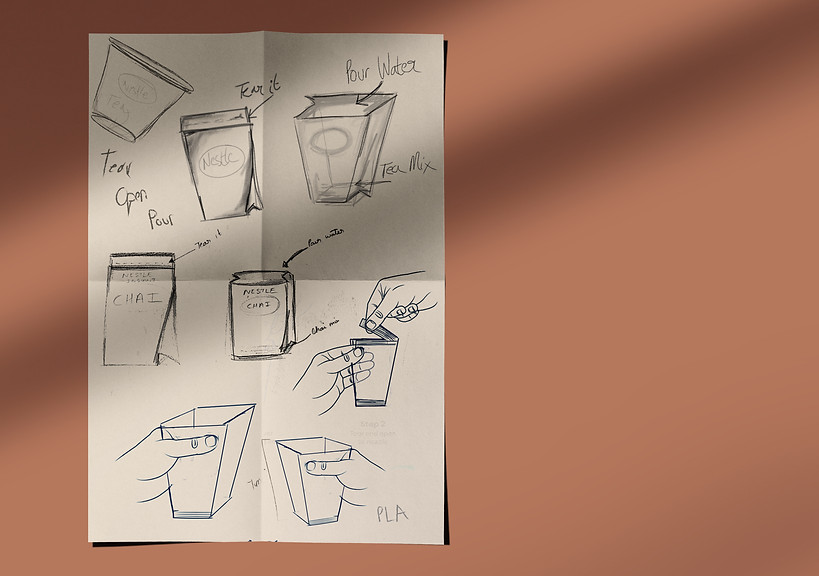

With research insights, design principles, and design opportunities finalized, I began to divergently ideate a response. Many rounds of user testing went into discovering the most natural and convenient ways for users to find the most convenient product.


Interacting with the users

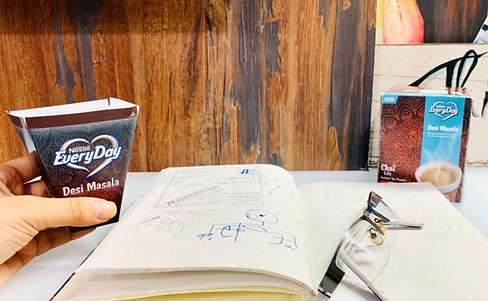


To test the ideas, I ran an experience prototype. At each stage of the paper prototypes I kept showing it to the target audiences to gain the feedback until I found they seemed excited to use the final end product. I came a long way starting from the first paper prototype which was bulky to a compact convenient pack.
Materiality and Structure
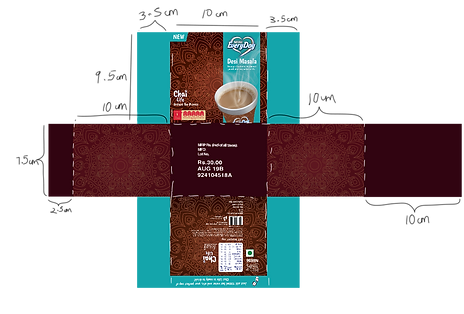

When one is constantly on the go, we Indians who love our 'Desi Masala' Tea, end up using a lot of plastic cups and tea bags. Keeping in mind the environmental effects of the same and to ease the process of consuming tea, I decided to work on this sachet while paying special emphasis on the material and the experience while consuming the product.
The sachet can be easily carried wherever you go especially in places where one cannot possibly carry their own mugs and tea bags.
Proposed Material
The proposed material is PLA (polylactic acid) is typically made from the sugars in corn starch, cassava or sugarcane. It is biodegradable, carbon-neutral and edible. PLA is biodegradable. It will convert into natural materials, such as water, carbon dioxide, and composite. This process is carried out by microorganisms and influenced by temperature and humidity.

Design Objectives
Portable
03.
Easy Of Use
An easy-to-carry box of 10 tea sachets “My Cuppa Tea” is a proposed solution to consume tea on the go.
The sachet is a biopolymer PLA that leaves no harmful residue in the environment. Unlike other paper cups, this Sachet is made from plant-based materials such as corn starch or sugar cane.
A simple sachet on tearing the top perforation and opening it up turns into a cup with the desi masala tea mix present inside it. Fulfilling your desi tea cravings any time and anywhere.
Sustainable
01.
02.
How does it work?


Learnings
User Testing
One does not need access to advanced facilities or tools to create a prototype, which shows the function of a design. My prototype allowed me to experience what it would be like to actually use the cup that I had designed.
Implemented feedback to iterate on designs efficiently at every stage of prototyping. Keeping the target audience and their needs as top most priority.
Prototyping
01.
02.
03.
Consumer needs
Ask what is it that the consumer wants to experience.By understanding their desires and goals, we can provide a more user-centered design.