
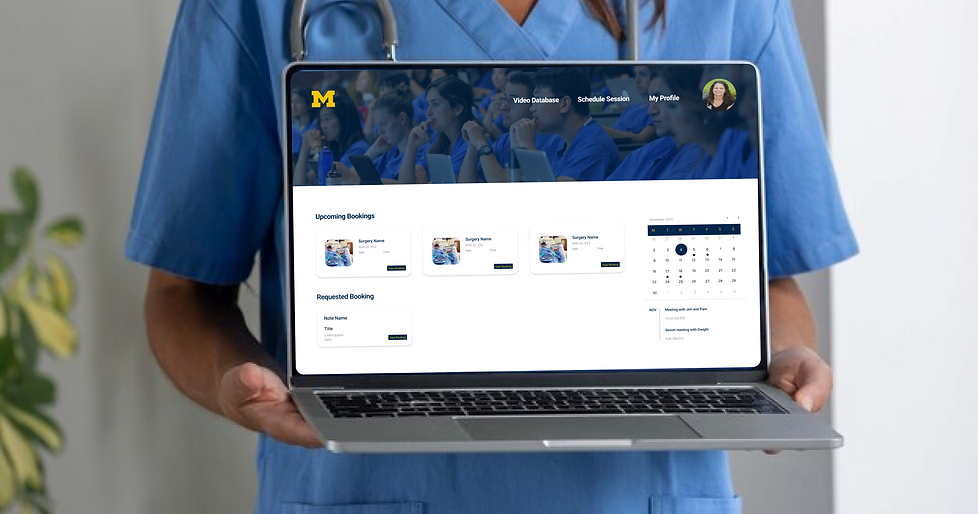

Postoperative Debriefing System
Industry Project- University of Michigan Medical School
Time Frame - September 2022 - December 2022 (10 weeks)
Tools Used - Adobe XD, Figma, Miro, Photoshop, Illustrator
Team Members - Anantika S, Akshay P, Alex Y & Tiana H
My Role:
Primary & Secondary Research, Competitive Analysis, Persona, Concept Development (sketches), & UX Design
The University of Michigan Medical School is lacking a standardized debriefing protocol for their surgical resident students within their training process, specifically current attending-to-resident instruction modules lack standardized feedback between resident surgeons and postoperative records of their surgery.
The Challenge
Design Goal
Improve upon the University of Michigan’s current surgical training methodology and postoperative review by either improving upon the current system or implementing new technology.

Process
Derived from the research findings and stakeholder meetings, we decided to use the following design process to go ahead with the study.

Who Are Our Users
Our users are busy saving as many lives as possible at the hospitals, They are the heroes who don't wear capes. How do we make their lives easier now...
We aim to make learning easier for all the attending surgeons waiting to save more lives and create impact.
Surgical Residents
Surgical Attending's
Admin/ Technical Staff


Understanding the system and core audience
To understand the need/motivations of University of Michigan's users and to identify areas in which an be improved, we conducted a thorough research over the course of the project.
-
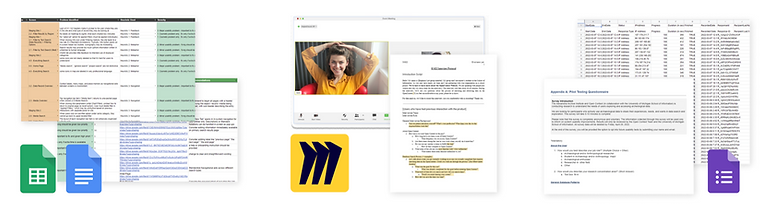
23 online resources & report articles analyzed to understand the current challenges with debriefing systems and their desired needs in creating a debriefing system
-
8 user interviews with UMICH Surgical Residents & Attendings to understand how they currently search for data
-
5 learning based tools competitors (direct & indirect) were looked into to help understand the existing tools & training methodologies
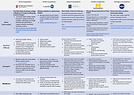
23 online articles
8 User Interviews
Competitor Analysis
Current Issues Discovered
We went through existing research, both academic and media-published, on pain points in physician training. Based on our primary research we discovered certain issues being faced by our target audience that are mentioned below.


Lack of
Time
Difficult to Review Procedure Footage
Inconvenient to communicate
-
Resident and attending physicians regularly work 60+ hours a week, sometimes going up to 80.
-
Within the 60-80 hours a week, there is very little down time to gather one’s self and have an analytical discussion.
-
During procedures, it can be incredibly difficult to find time to properly debrief and discuss the events that are occurring to the residents. use for learning at Michigan Medicine.
-
Procedures and surgeries are generally not recorded clearly or in high enough definition to allow for physicians to review
-
There is no method for physicians to annotate video recordings such that notes can matched with a certain point in the video
-
It is not common procedure to turn on recording devices prior to procedures due to the non user-friendly nature of procedure recording software in the first place
-
Both residents and physicians have a multitude of responsibilities that require them to have a sense of urgency in moving from task to task.
-
The hectic nature of clinical environments makes it difficult for physicians to sit down and debrief with one another.
-
This difficulty in finding space for communication in tandem with time makes clear transfer of learning of information difficult.
Getting direct insights from our users - User Interviews
We conducted semi-structured interviews with the resident surgeons and attendings, asking about their experiences with the current debriefing sessions, and the procedures used and what could be done to improve the debriefing system while integrating technology.
7+
Interviews

a.jpg)

a.jpg)


a.jpg)


User Interview Goals
Explore Current
Practices
Understand the tools, resources, and platforms they currently use for learning at Michigan Medicine.
Explore Motivations for Learning
Assess Learning Preferences
Identify factors that can enhance their motivation and engagement with the learning platform.
Explore learning preferences, such as self-paced learning, collaborative learning, or instructor-led sessions.


Unraveling the needs - User Interview Insights
Interview - Key Findings

01
What are the ways to encourage residents who might not otherwise be interested in using video technology to engage in video technology for further learning.
02
Are there ways to maintain prioritization of feedback and tasks to be fixed as digital feedback in the moment of surgery may be rushed and may not convey the urgency of a certain technical gap with the residents.
03
How can we allow for senior medical staff to give quick, clear, anonymized feedback without compromising focus on surgical tasks at hand.
User Personna
After understanding the broader problem space, we began to narrow down and understand how the within work environments. We created personas ( resident and attending surgeon ) to clarify our primary stakeholders and understand their goals, motivations, and pain points


Sketching
Our
Ideas out
SESSION GOALS
-
Validate the concept ideas
-
Gather additional use cases to help refine the concepts
-
Brainstorm more features and functionalities
The team first devised 14 ideas to build connections with the challenge. We down-selected our ideas based on feasibility, usability, and scalability.


Downsizing
Potential
Solutions
As for potential solutions to the issues identified in our problem statement, we have four potential solutions that could be implemented to help increase the efficiency of their postoperative debriefing system.

The first is bookmarking software platform, where users can mark specific points within the video where they see an error or make a note within a point in the video. Video-enhancing learning in surgical training dramatically reduces patient harm.
A virtual reality (VR) training modules would add incredible benefit to surgical training. Given that surgical devices are difficult to access and can be difficult to reach, VR would allow training surgeons to practice in a simulated environment that is similar to using a real surgical device.
Receive feedback from students about how the training process could be improved. Collect this feedback and focus on most prevalent trends in where students feel the training process is lacking. Feedback collection would occur on the collaborative interface.
An innovative formal learning program based on a major surgical textbook with weekly testing and small group sessions can significantly improve surgical training in the modern era of work-hour restrictions.


Deciding on the final solution using QOC method
As a group we decided that the following tools were to be omitted from the QOC because they did not meet the user requirements indicated by our needfinding and persona analysis, in order to improve the efficiency of the surgical debriefing and feedback process of the University of Michigan School of Medicine:
Narrative Storyboard


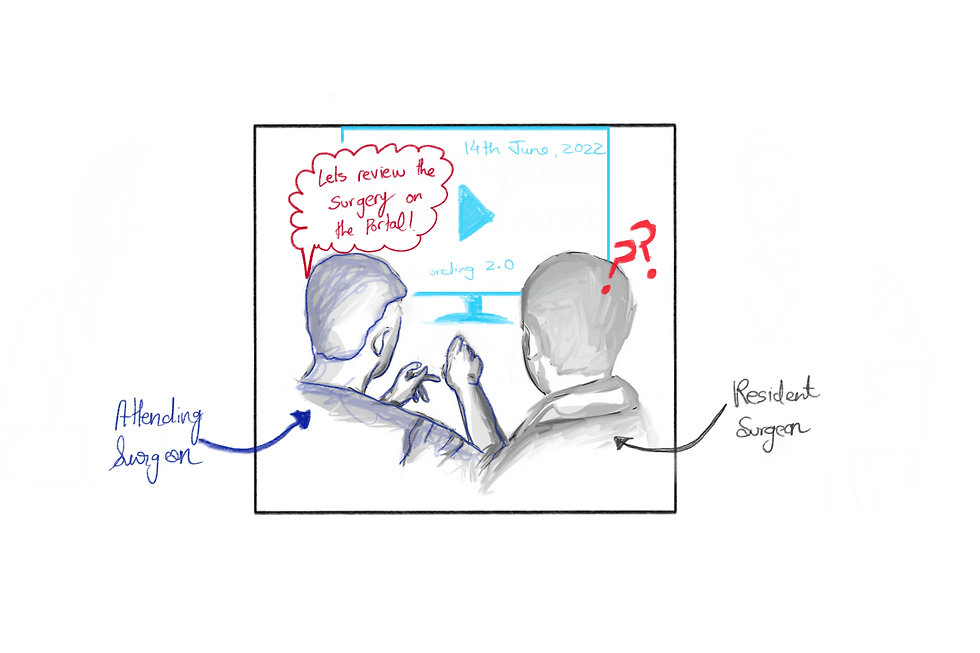
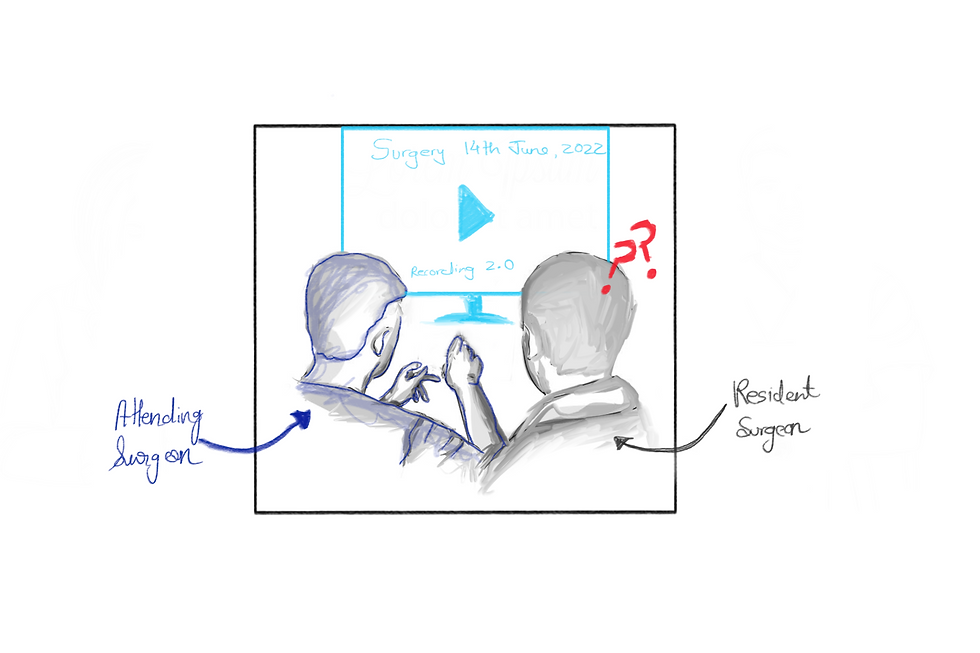

After selecting the solution/tool, we were going ahead with I illustrated the experience of our prototype. This helped us structure the flow of the application and get our vision to paper
User Flow Task Mapping
As a group we worked on the flow of the tasks that the users would be following, this process helped us think about the various screens and navigations that would be required to perform the tasks.


Thinking Through the Structure
Based on the feedback we received, we put in a conscious effort to think through every interaction and bring consistency as we build our user flow. The structure is intentionally simple to make the process smoother.

Behind the Scenes- Wireframes

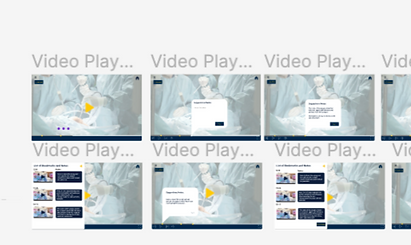
Once we determined key interactions through our storyboard, we fleshed out the interactions in more detail by making lo-fi screens. Below are the main user flows that would occur in the scenario depicted in our storyboard.



How might we validate designs- Usability Testing

At this point, we asked a few of our participants for feedback on our design. We showed them our storyboard, explaining the purpose of this platform and how one might use it. We then showed them our screen designs.
The overall concept seemed to be well-received by our participants, but they did provide us some very helpful insights and pointed out areas that would benefit from further clarification.
Design Hypothesis
Through our prototypes, we wanted wanted to test usability and assess whether our designs added value. Our design hypotheses were as follows:
Engagement
Track Progress
Transparency
The resident surgeons can keep a track of their progress along with their mentors being able to review how far their students have come along
The proposed Re-Video portal will allow both the resident and attending surgeons to engage together and stay up to date with procedures
With Re-Video the residents now have the transparency to see when their mentors are available and keep the loop going to set up connects with their mentors
1
2
3
3-
2-
1-
Users can complete the tasks quickly & with no trouble
Users can perform the tasks but has some struggles
Users can't perform the tasks


80%
Time Effective
4 out of 5 participants felt the proposed CX would make debriefing and scheduling process easier & quicker
100%
Content Quality
5 out of 5 participants felt the details displayed and proposed CX was very relevant to their current needs.
100%
Idea Success
5 out of 5 participants felt they would want to see and use the proposed CX live as it would help with enhanced training.
Design System
We developed a set of brand values to set an intentional standard for our product design. Unanimously we decided to go with the Michigan Maize and blue colour as a brand style, which both calms and stimulates our bodies, making the users feel this is a part of the Michigan environment. Our prototyping results helped us decide on the necessary interactions on the devices.

Introducing Re-Video
The Re-Video interface is a one-in-a-kind innovative surgical review debriefer that allows resident physicians to book meeting times with attending physicians and for residents + attendings to review procedural + surgical footage to facilitate learning.


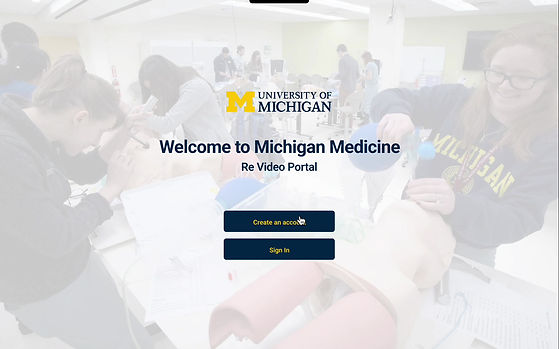

Easy Sign in
Set up account quickly based on your user role via your university of Michigan id
Upload data on a click
Post surgical sessions, videos and other resources for post-operative trainings can be added to the serve easily & quickly.
Schedule sessions on
the go.
Resident surgeons can now check their mentors calendar and schedule sessions for mentorship time and clarifications.

Making training & feedback more standardized and transparent, allowing the residents to revisit and gain feedback wherever they feel the need for additional support.


Bookmark your doubts
Residents can now re go through surgery videos and bookmark areas where they need information.
Real time notes updated between mentor and mentee.
The project was a great success and was presented to facilities of the Learning Health Sciences and is being continued to develop by the second batch of interaction design program.
Prototype stage 1 was sent to client research team and development team for implementation & testing down-the-road


Learnings & Reflections
To design a strong medical education product, both a strong design sense and a deep understanding of the subject is required. Sometimes a simple solution can cause significant results.
Through a need-finding interview with a General surgery resident, we learned not only about what technologies were available as far as surgical instruction goes, but we learned about the culture in which residents and attendings interact. Interpersonal communication was something to be taken into consideration as well in terms of what issues we hoped to tackle with our solution.
All-in-all, we learned that we were designing for not only residents, but attendings, as well as communication between the two parties, was a bridge that we hoped to help build, we learned that certain hardware and software technologies already exist and can be incorporated into our solution, and we learned that the domain of medicine was one that held many other considerations that we addressed in our prototype including culture & data privacy.